Sensory analysis of coffee for beginners - how to identify acidity, body and aftertaste in a cup
Amir Jabri | 23 February 2026
Drinking coffee is an essential morning ritual for most of us, but the world defined by specialty coffee, offers much more than just a quick dose of caffeine. Sensory analysis – the ability to consciously identify flavors, aromas, and textures – is not the privilege of professionals at world competitions. It is a practical tool for every coffee lover who wants to truly understand the quality in the cup and not be influenced only by nice packaging when buying.
In the following lines, we will teach you how to turn ordinary drinking into conscious tasting. Understanding the basic pillars, such as acidity, body, and aftertaste, will allow you to precisely name why you like a specific bean, and will make it easier for you to choose your next favorite coffee.
Why start with conscious tasting
Most people perceive coffee as one homogeneous beverage with a "coffee" taste. Specialty coffee however, it carries the genetic code of the country of origin, processing methods, and the roaster's work. Training your senses will bring you three basic benefits:
Better choice when buying: When you know that you prefer sparkling apple acidity over a dense chocolate body, you can purposefully orient yourself to specific regions, for example, to high-altitude Kenya instead of Brazil.
Optimization of home preparation: If you feel an unpleasant bitterness in the cup, sensory analysis will tell you that you need a coarser grind or a lower water temperature.
Ability to identify freshness: You will learn to distinguish between the complex aftertaste of freshly roasted beans and the empty, earthy taste of coffee that has spent too much time on a supermarket shelf.
Preparation for sensory training
Before you dive into the analysis of acidity or body, it is important to follow a few technical principles that will ensure the objectivity of your perceptions:
Water purity: Since coffee is 98% water, use exclusively filtered water with a low mineral content. Hard water can completely "kill" the delicate acidity of even the best roasted beans.
Cup temperature: Never evaluate coffee right after pouring. Our taste receptors perceive the most details at a temperature around 50-60 °C. As the coffee cools, its chemical composition changes and the flavor profile becomes clearer.
Do not use sugar or milk: Any addition changes the structure of the body and masks the natural acidity of the bean. Sensory analysis requires a pure black beverage.
Acidity – the spark you are looking for in coffee
In everyday language, acidity is often confused with unpleasant sourness. In commodity coffee, sourness is the result of defective, unripe beans or too dark roasting, which masks poor quality. However, in the world specialty coffee acidity is a desirable attribute that gives the beverage life, brightness, and complexity.
How to identify it: Focus on the places where you perceive the taste of apple or lemon – that is, on the sides of the tongue and the front of the mouth. Quality acidity is clean and refreshing.
Types of acidity: In coffee, we distinguish mainly organic acids. Citric adds freshness, malic brings juiciness, phosphoric is responsible for a sparkling sensation, typical for Kenyan coffee, and lactic acid reduces the sharpness of other acids and contributes to overall sweetness and complexity.
Origin and processing: High-altitude conditions slow down the ripening of coffee cherries, which concentrates acids in the bean. Examples are the bright flavor profiles that Amir and Jakub looked for during a specialty trip in Kenya.
Body is not a flavor component, but a tactile sensation. It describes the viscosity, weight, and texture of the liquid in the mouth. It is created by a combination of coffee oils and microparticles that were released into the water during extraction.
Sensory exercise: Try to "roll" the coffee in your mouth like wine. Does it feel like light water, or does it rather have the density of syrup or cream?
Body scale:
Light: Clean, reminiscent of tea. Typical for light roasting and the method .
Creamy: Texture of semi-skimmed milk, chocolate tones.
Heavy: Viscosity of syrup, prominent especially in espresso preparation.
Factors affecting the body: The grinding method and preparation method play a key role. While a filter catches oils, a metal sieve lets them through, thereby increasing the perceived density.
Aftertaste – the signature that coffee leaves
Aftertaste is the sensations that remain in the mouth after swallowing. It is a critical indicator of quality, because it is the aftertaste that decides whether you want another cup.
Length of aftertaste: Quality coffee should have a lingering aftertaste that gradually changes. If the taste disappears immediately, the coffee is flat. If an unpleasant bitterness remains, we speak of a defect.
Clean cup: A professional term that defines the absolute cleanliness of the cup without disturbing elements from the first sip until it cools down completely. It is achieved only by precise processing on the farm and in the roastery.
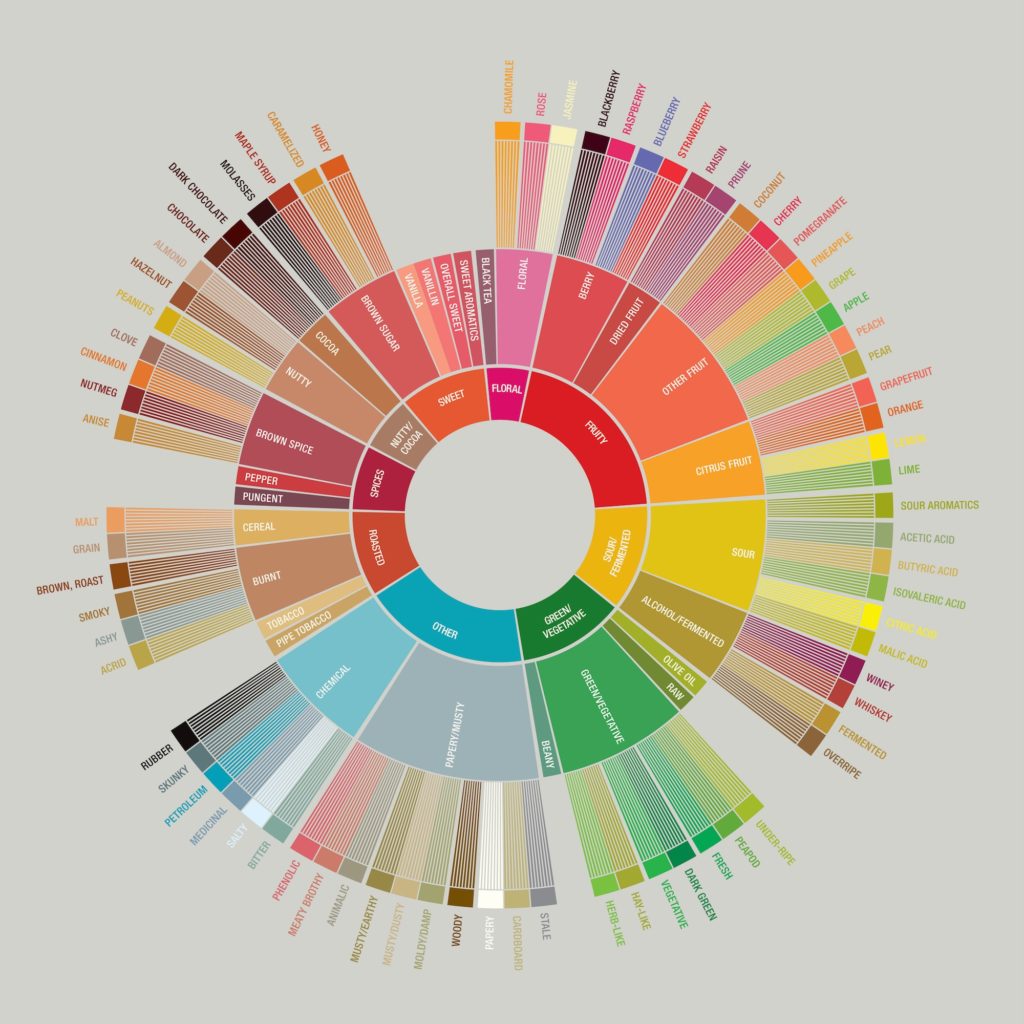
Practical exercise with the SCA flavor wheel
The flavor wheel, developed by the Specialty Coffee Association (SCA), represents a scientific code for the sensory evaluation of coffee. It helps to connect abstract taste sensations with objective terminology, which is essential for the correct calibration of your taste buds.
How to use the wheel correctly: Using the wheel is intuitive and based on proceeding from the general to the specific. When tasting, always start in the very center of the wheel, where the most general flavor categories are located (e.g., fruity, sweet, floral, or nutty).
Once you determine the basic direction, proceed towards the outer edges of the wheel. Each subsequent ring brings more specific descriptors. For example, if you identified a "fruity" flavor in the center, in the next step you will find out whether it is "berries" or "dried fruit". At the very edge of the wheel, you can accurately name a specific note, such as "blackberry", "blueberry", or "raisin". This process will allow you to go from a simple feeling of "I like it" to a professional description of the flavor profile of your cup.
Objectification of the experience: It allows you to move from describing "it's good" to terms like "malic acidity" or "dark chocolate aftertaste".
Memory training: By repeatedly using the wheel, you build mental associations with specific flavor profiles, which will make your future coffee purchases easier according to your preferences.
Frequently asked questions about coffee tasting
Why does coffee get bitter as it cools? In reality, coffee does not get bitter, but our taste buds are more sensitive to various flavor components, including acidity and bitterness, at lower temperatures. With a hot beverage, the perception of temperature and body dominates.
What if I don't taste any fruit in the coffee? This can be caused by hard water, which neutralizes acids, or an incorrect grind ratio. Try a finer grind to increase flavor extraction.
Does decaffeinated coffee taste different? When using top technologies like , the aromatic oils and body structure remain preserved, so you won't notice a difference in the aftertaste.
Co-founder of Goriffee, who was personally responsible for coffee roasting for the first 10 years. He later deepened his experience by completing a course with world-renowned expert Scott Rao. Today, he is fully dedicated to quality control and bean selection – this year alone, he tasted more than 2 500 samples to find the best specialty coffee for you.
Na ukladanie a/alebo prístup k informáciám o zariadení používame technológie ako cookies. Robíme to s cieľom zlepšiť zážitok z prehliadania a zobrazovať (ne)prispôsobené reklamy. Súhlas s týmito technológiami nám umožní spracovávať údaje, ako je správanie pri prehliadaní alebo jedinečné ID na tejto stránke. Nesúhlas alebo odvolanie súhlasu môže nepriaznivo ovplyvniť určité vlastnosti a funkcie.
Funkčné
Vždy aktívny
Technické uloženie alebo prístup sú nevyhnutne potrebné na legitímny účel umožnenia použitia konkrétnej služby, ktorú si účastník alebo používateľ výslovne vyžiadal, alebo na jediný účel vykonania prenosu komunikácie cez elektronickú komunikačnú sieť.
Predvoľby
Technické uloženie alebo prístup je potrebný na legitímny účel ukladania preferencií, ktoré si účastník alebo používateľ nepožaduje.
Štatistiky
Technické úložisko alebo prístup, ktorý sa používa výlučne na štatistické účely.Technické úložisko alebo prístup, ktorý sa používa výlučne na anonymné štatistické účely. Bez predvolania, dobrovoľného plnenia zo strany vášho poskytovateľa internetových služieb alebo dodatočných záznamov od tretej strany, informácie uložené alebo získané len na tento účel sa zvyčajne nedajú použiť na vašu identifikáciu.
Marketing
Technické úložisko alebo prístup sú potrebné na vytvorenie používateľských profilov na odosielanie reklamy alebo sledovanie používateľa na webovej stránke alebo na viacerých webových stránkach na podobné marketingové účely.