Kenyan coffee classification: what do the abbreviations AA, AB, PB or E mean?
Amir Jabri | July 30, 2026
Letters such as AA, AB, or PB on a Kenyan coffee label are often perceived as direct quality grades—like medals of excellence. In reality, they denote purely physical attributes: the size, shape, and density of the green beans after dry milling. It is also not the case that one tree yields exclusively "AA" and another "AB." All these grades originate from the very same harvest, the same coffee cherry, and the same Kenyan hillsides.
The Kenyan grading system is among the most meticulous in the world, serving roasters and Specialty coffee enthusiasts alike as a key to understanding how the coffee behaves during roasting and what to expect in the cup.
Wet grading (by density)
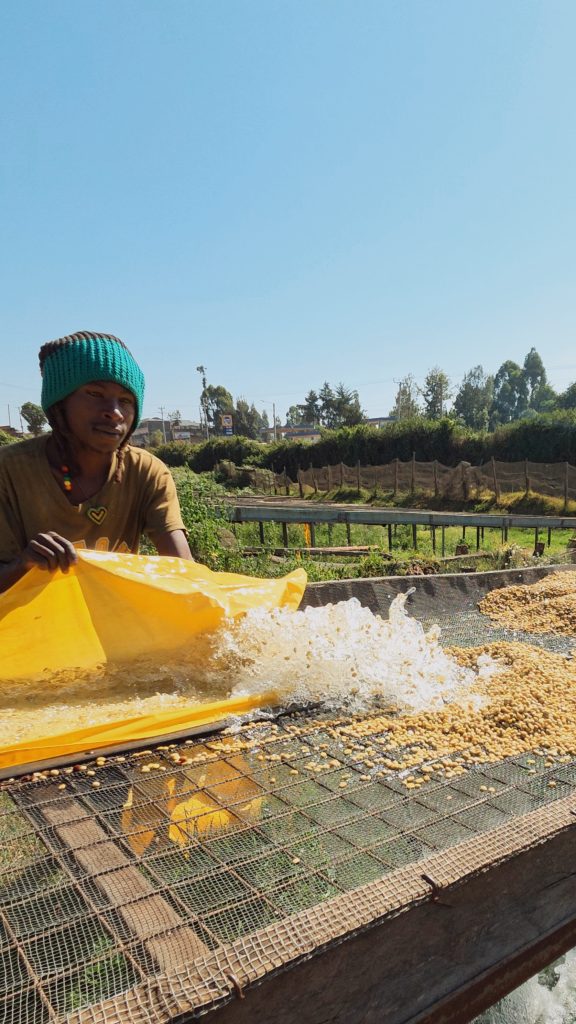
Kenya almost exclusively utilizes the washed process. The initial grading begins immediately after harvest.
Flotation: Freshly harvested cherries are submerged in water tanks. Overripe, dried, or defective cherries float to the surface and are removed immediately.
Washing channels: Following pulping and fermentation, the beans are washed in long water channels. Simple physics applies: the densest, highest-quality beans (P1 and P2) are heavy and sink to the bottom near the head of the channel, while lighter, less developed beans (P3) are carried downstream by the flow.
How bean grading works in Kenya: from screen sieves to gravity tables
After the coffee cherries undergo wet processing (notably Kenya's signature double fermentation), dry on raised African beds, and are hulled of parchment at the dry mill, mechanical grading begins. It relies on three primary principles:
Size (screen size): Green beans pass through a series of perforated metal screens with apertures graded in increments of 1/64 of an inch.
Bean shape: Flat beans are separated from natural mutations (peaberries).
Density: Pneumatic air classifiers and gravity tables separate lighter or hollow beans from heavy, dense ones.
Comprehensive overview of Kenyan grades
Grade
Screen size / specification
Profile and physical characteristics
E (Elephant)
Screen 18+ (above 7.2mm)
Oversized beans formed when two seeds fuse together inside a single cherry. They often split during processing, leaving behind characteristic "ears." Rare and full-bodied, yet requiring careful heat application during roasting.
AA
Screen 17/18 (approx. 7.2mm)
The largest and typically densest standard flat beans. They deliver pronounced acidity and exceptional complexity, though they require a substantial heat transfer during roasting.
AB
Screen 15/16 (6,8–7.2mm)
A combination of grade A and B beans. Accounting for approximately 40% of total production, it is typically more balanced in the cup, with softer acidity and a rounder body than AA.
PB (Peaberry)
Approx. screen 17 (round)
A natural mutation (approx. 5–10% of the crop) where a single round bean develops inside the cherry instead of two. It is very dense and rolls exceptionally evenly in the roaster drum. The flavor profile is typically concentrated and remarkably sweet.
C
Screen 14/15
Smaller, thinner beans screened out from the AB category. When sourced from high altitudes, they can surprise with their cup clarity, though they generally trade at a lower price point.
TT
Air classification
Lighter beans separated by airflow from the E, AA, and AB grades. They have lower density and less developed sugars.
T
Screen below 12 / fragments
Broken, damaged, or very small fragments. Primarily destined for commercial blends on the domestic market.
MH / ML (Mbuni)
Naturally dried
Cherries that fell from the tree or dried out directly on the branch (mbuni). A coffee with a higher incidence of defects, typically harsher, astringent, or grassy.
Size vs. quality: the myth of the "all-powerful" AA
The most prevalent consumer myth (and a frequent topic of debate on forums like Reddit) is the assumption that AA automatically equates to the finest coffee. Physical bean size, however, is merely one parameter.
Bean size and cup quality are two distinct metrics. For this reason, Kenyan coffees undergo sensory evaluation (cupping) independently after size grading to assess clarity, acidity, body, and overall flavor profile. A high-scoring AB or PB lot can easily outperform an average AA lot from the same farm.
Why, then, are larger AA beans so prized? The primary factor is elevation. Coffee trees cultivated at altitudes above 1700 m a.s.l. mature more slowly, accumulating more sugars and organic acids, resulting in exceptionally dense, large beans. Bean size in AA is thus a direct consequence of exceptional terroir, yet not an automatic guarantee of cup quality.
Roasting and brewing: why bean size matters in the roastery?
The primary reason coffee in Kenya is strictly graded by size is roasting consistency. If you were to roast small C-grade beans together with massive E or AA beans in a single drum, the smaller beans would burn before the larger ones were properly developed inside.
Kenyan beans graded AA and PB are renowned for their exceptional density. During roasting, they require a higher initial charge temperature to ensure the heat penetrates all the way to the core without scorching the surface.
In most cases, AA delivers a better cup profile than AB, though not always. In the roastery, taste is what ultimately matters most. If you see an AB grade in our selection, it does not mean it is inferior coffee; it is often an outstanding coffee at a more accessible price.
Frequently asked questions
Is it worth buying AB coffee if it is more affordable than AA?
Absolutely. At the Nairobi Coffee Exchange auctions, AA is highly sought after as a prestigious grade, which drives up its price. However, AB coffee from the same farm offers equally complex fruity notes (blackcurrant, citrus) with slightly milder acidity, often representing the best value for money.
Is Peaberry (PB) truly sweeter and more intense?
Since only a single seed develops inside the cherry instead of two, this lone bean absorbs all the nutrients. PB beans are naturally round, dense, and absorb heat more evenly during roasting. In the cup, this often translates into more pronounced sweetness and vibrant acidity.
What are "Elephant beans" (E) and why are they rarely seen on menus?
Grade E represents a genetic anomaly where two beans within a cherry literally fuse into a single giant one. However, during pulping and drying, they shatter easily and create irregular fragments. Due to their low volume, they are usually separated or blended into special microlots.
Taste our coffee from Kenya, which we personally selected at the farm
We bring you the very first specialty coffee from this year's fresh harvest. This Kenya is truly special to us – we selected it personally during our trip to Africa in February 2026, where we cupped more than 400 samples. The Kagumo washing station, established back in 1951 on the volcanic slopes of Mount Kenya, won us over immediately.
Co-founder of Goriffee, who was personally responsible for coffee roasting for the first 10 years. He later deepened his experience by completing a course with world-renowned expert Scott Rao. Today, he is fully dedicated to quality control and bean selection – this year alone, he tasted more than 2 500 samples to find the best specialty coffee for you.
Na ukladanie a/alebo prístup k informáciám o zariadení používame technológie ako cookies. Robíme to s cieľom zlepšiť zážitok z prehliadania a zobrazovať (ne)prispôsobené reklamy. Súhlas s týmito technológiami nám umožní spracovávať údaje, ako je správanie pri prehliadaní alebo jedinečné ID na tejto stránke. Nesúhlas alebo odvolanie súhlasu môže nepriaznivo ovplyvniť určité vlastnosti a funkcie.
Funkčné
Vždy aktívny
Technické uloženie alebo prístup sú nevyhnutne potrebné na legitímny účel umožnenia použitia konkrétnej služby, ktorú si účastník alebo používateľ výslovne vyžiadal, alebo na jediný účel vykonania prenosu komunikácie cez elektronickú komunikačnú sieť.
Predvoľby
Technické uloženie alebo prístup je potrebný na legitímny účel ukladania preferencií, ktoré si účastník alebo používateľ nepožaduje.
Štatistiky
Technické úložisko alebo prístup, ktorý sa používa výlučne na štatistické účely.Technické úložisko alebo prístup, ktorý sa používa výlučne na anonymné štatistické účely. Bez predvolania, dobrovoľného plnenia zo strany vášho poskytovateľa internetových služieb alebo dodatočných záznamov od tretej strany, informácie uložené alebo získané len na tento účel sa zvyčajne nedajú použiť na vašu identifikáciu.
Marketing
Technické úložisko alebo prístup sú potrebné na vytvorenie používateľských profilov na odosielanie reklamy alebo sledovanie používateľa na webovej stránke alebo na viacerých webových stránkach na podobné marketingové účely.