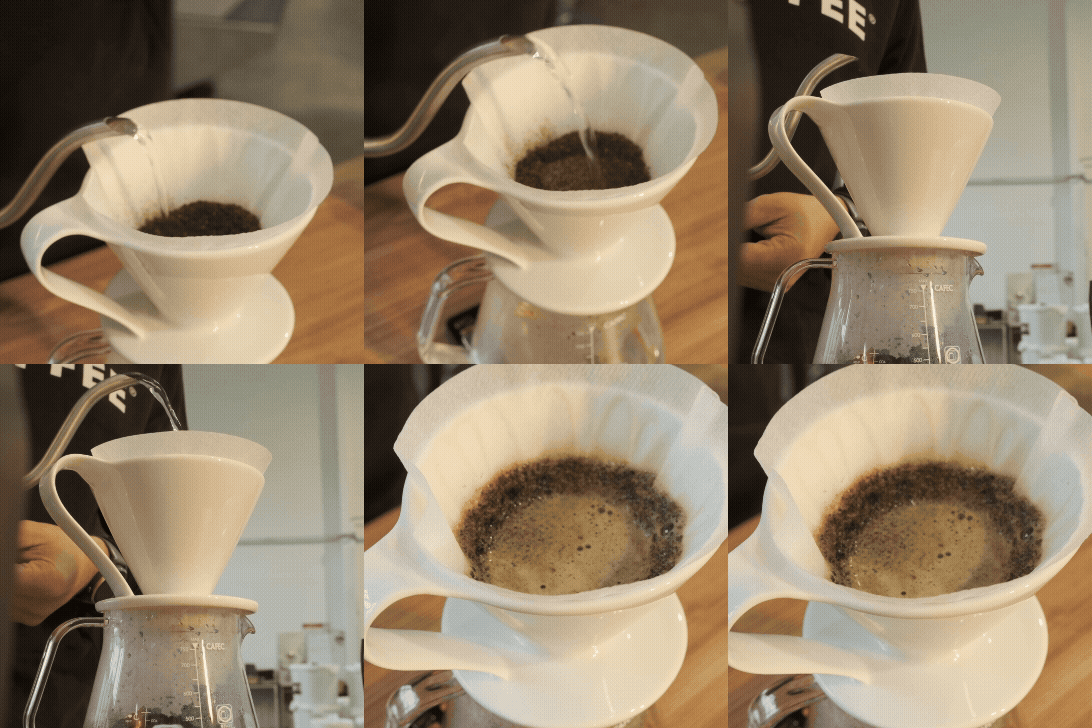
Our colleague, friend, and above all experienced barista Šimon Janík has prepared a series of articles about "home brewing" for you. In short, it's about how to make great coffee in the comfort of your home. The first article in our series covers brewing with the popular Hario V60 method.
Why filter coffee? Filter coffee offers more delicate and cleaner flavors than classic espresso, allowing the character of the specific bean to stand out fully.
The secret to perfect homemade coffee
Before we begin with the recipe, it is important to understand the fundamentals. Whether you are in our coffee shop in Bratislava or at home in your kitchen, the foundation is quality ingredients and freshness.
As advised by our colleague Šimon Janík, Slovak Barista Champion for the year 2019:
"There are several ways to brew quality coffee at home. They are affordable and easy to prepare. To start with, I would recommend the Hario V60, AeroPress, Chemex, or French press. I also recommend getting your own grinder and grinding fresh coffee right before brewing. Such coffee has far more flavors and aromas than pre-ground coffee."
So, let's take a look at how to get the most out of your V60.
Basic V60 recipe
- Coffee: 20 g (we recommend a lighter roast, ideally marked as "filter roast")
- Water: 300 g
- Water temperature: 96 °C
- Grind: Medium-coarse (resembling sea salt)
- Total time: 2:30 – 2:45 min
Step-by-step brewing guide
Preparation: Place a paper filter into the V60 dripper and rinse it thoroughly with hot water. This step eliminates any paper taste from the filter while preheating both the V60 and the decanter (the vessel beneath it). Discard the rinse water from the decanter.
Step 1: Weighing and grinding Place the V60 with the decanter on your scale. Add 20 grams of freshly ground Specialty coffee, gently tap to level the coffee bed, and tare the scale. Prepare your timer.
Step 2: Blooming Start the timer. Pour 50 g of water in a circular motion to ensure all the coffee is fully saturated. Gently swirl the V60 or stir the coffee with a spoon. Wait 30 seconds. During this process, CO2 is released and the coffee undergoes "blooming".
Step 3: First pour Once 30 seconds have elapsed, begin pouring water in a slow and steady circular motion up to a total weight of 200 g. Direct the stream of water evenly onto the coffee bed, avoiding the walls of the filter.
Step 4: Second pour At 1:30, pour the remaining water, again in a circular motion, up to the final weight of 300 g. Finally, give the V60 another gentle swirl (a "spin") to flatten the coffee bed and ensure an even drawdown.
Step 5: Final stage and serving The total extraction time should be between 2:30 and 2:45. Once the water has completely drained through, remove the filter.
Don't be afraid to experiment
Take this recipe as a starting point, not an unchangeable rule. Every specialty coffee is different – it has a different density, roast level, and flavor profile. Therefore, don't be afraid to experiment and adjust the recipe to your liking. Your best tool for calibration is the grinder:
- If the coffee tastes too bitter: If you notice an unpleasant bitterness in the aftertaste, the coffee has been over-extracted. Next time, choose a coarser grind.
- If the coffee is watery and weak: If the flavour lacks intensity, the water has passed through too quickly. Next time, choose a finer grind.
Look for the right balance (the "sweet spot"), where the coffee is sweet, fruity, and pleasant.
A quick tip from Goriffee: Do not forget to swirl the coffee in the decanter before serving. Flavours are extracted gradually and in distinct layers – swirling blends them into a harmonious whole.
Don't drink filter coffee immediately after brewing. Wait about 2-3 minutes until it cools down slightly. Specialty coffee develops its fullest flavor profile at around 60-70 °C.
Frequently asked questions (FAQ) about V60 brewing
1. Do I need a dedicated gooseneck kettle? While it is not strictly mandatory, a kettle with a contoured gooseneck spout will make your life significantly easier. With the V60, pouring water steadily and slowly is essential. Using a regular kettle makes it difficult to control the flow rate, which can lead to uneven extraction. If you are serious about brewing coffee at home, investing in such a kettle is certainly worthwhile.
2. Why rinse the paper filter? Rinsing the filter with hot water before adding coffee serves two main purposes. First, it washes away any undesirable "papery" taste that might otherwise carry over into your cup. Second, the hot water preheats the ceramic or glass V60 dripper and decanter, helping your coffee maintain its ideal temperature for longer.
3. What water should I use to brew coffee? Coffee is 98% water, so its quality fundamentally affects the final taste. Tap water, especially in Bratislava and surrounding areas, is often too hard and chlorinated, which "kills" the delicate fruity notes of specialty coffee. We recommend using filtered water (for example, from a BWT or Brita filter pitcher) or spring water with a low mineral content.
4. When is coffee at its best for filter brewing after roasting? Freshly roasted coffee needs time to "degas." Right after roasting, it contains a lot of carbon dioxide, which prevents proper flavor extraction. The ideal time to prepare filter coffee is approximately 10 days to 4 weeks from the roast date.
5. What is the difference between grinding for espresso and for V60? The grind for V60 must be noticeably coarser than for espresso. While you need a fine powder for espresso (like all-purpose flour), for V60 you are looking for a consistency resembling sea salt or granulated sugar. If you were to grind the coffee too fine, the filter would clog, the water wouldn't flow through, and the result would be unpleasantly bitter.
Taste some of our new filter coffees for V60

Šimon from Goriffee
Slovak Champion in the Barista category (2019) and an important part of the Goriffee team for years. He got into coffee during his studies at the Hotel Academy in Piešťany, where he co-founded the educational project Academic Barista. At Goriffee, he currently focuses mainly on sales, building B2B relationships, and caring for existing and new customers. Besides that, he leads barista trainings and workshops, bringing his experience from competitions and behind the bar into everyday work with coffee – from selecting the right beans to setting up processes in a cafe.